Where Good Sketches Go to Die: Crossing the Analog-Digital Divide
It is 4:00 PM on a Tuesday, and you have just achieved peak intellectual enlightenment. For the last ninety minutes, you and your team stood around a whiteboard—or you crouched over your iPad or reMarkable tablet—mapping out a sprawling system architecture, a killer product flow, or the tangled web of your latest research. There are color-coded boxes, frantic arrows of pure inspiration, and a brilliant little doodle in the corner that ties the whole concept together.
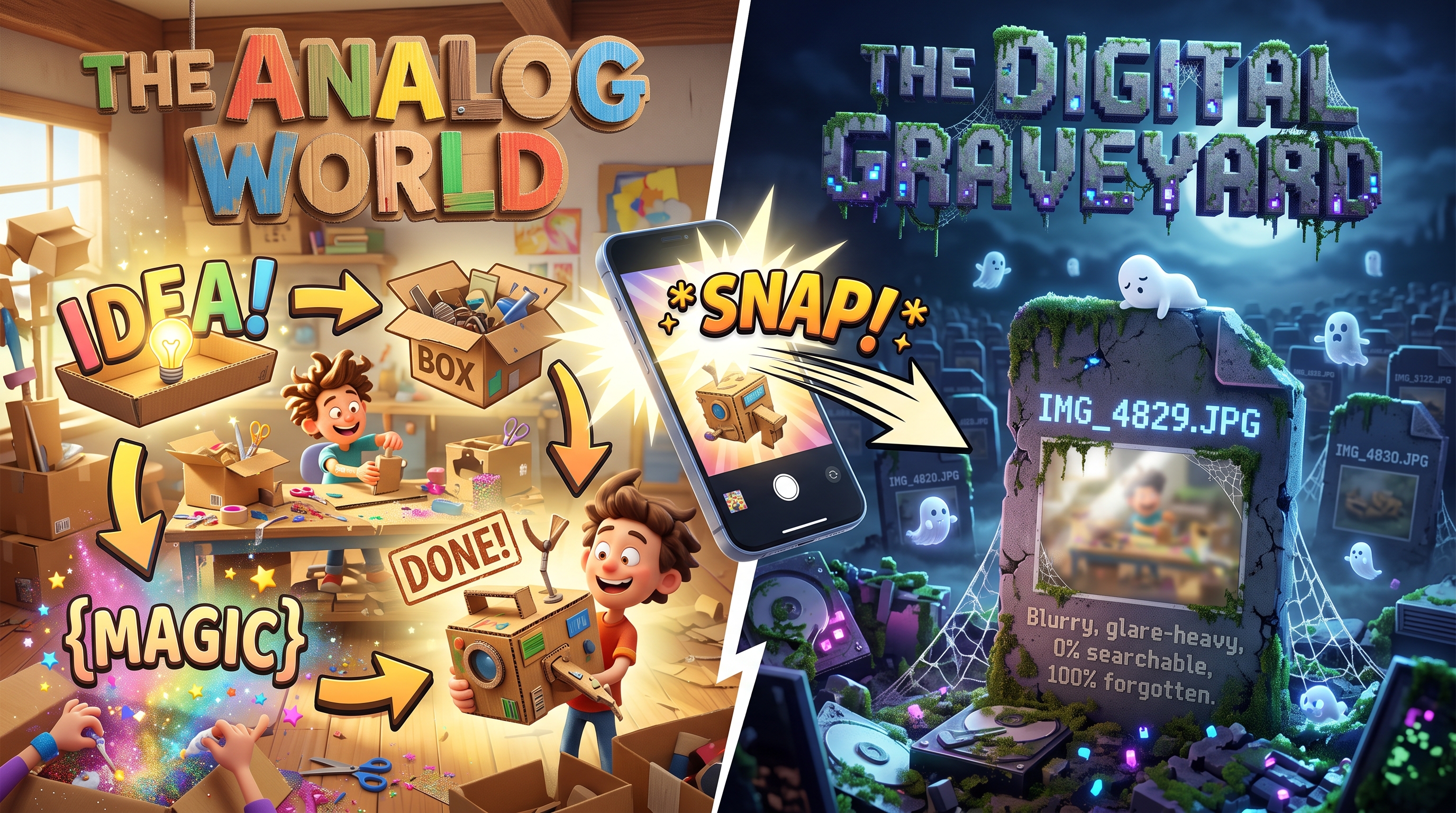
Nobody touches the board. Someone pulls out a phone, snaps a slightly crooked photo with a glaring fluorescent light reflection right in the middle, and drops it into the team chat or their personal knowledge vault. Everybody nods, feels productive, and goes
And just like that, your brilliant diagram enters the Digital Graveyard.
Why Our Brains Refuse to Give Up the Pen
You might wonder why we don't just type everything from the start. The truth is, our brains are wired for the pen. Cognitive psychology and neuroscience have repeatedly shown that handwriting and sketching engage widespread neural networks associated with memory, spatial reasoning, and deep conceptual processing. When we type, we tend to fall into mindless verbatim transcription. When we write and draw by hand, the slight physical friction forces our brains to synthesize, summarize, and map out relationships spatially.
In short: we think better in 2D space than in linear lines of text. On a blank page or a whiteboard, positioning is syntax. A big box means "important," a dashed arrow means "maybe later," and a scribble in the margin means "don't forget this edge case".
The Great Barrier: When Spatial Magic Meets Linear Databases
The tragedy begins the moment you try to bring that spatial magic into your digital "Second Brain". Whether you are a devoted Obsidian vault architect, a Notion wizard, or an Evernote veteran, you immediately hit a massive wall.
People who think on paper, whiteboards, or E-Ink tablets quickly end up maintaining two completely disconnected knowledge bases: the typed one they can actually search and link, and the handwritten one they can't.
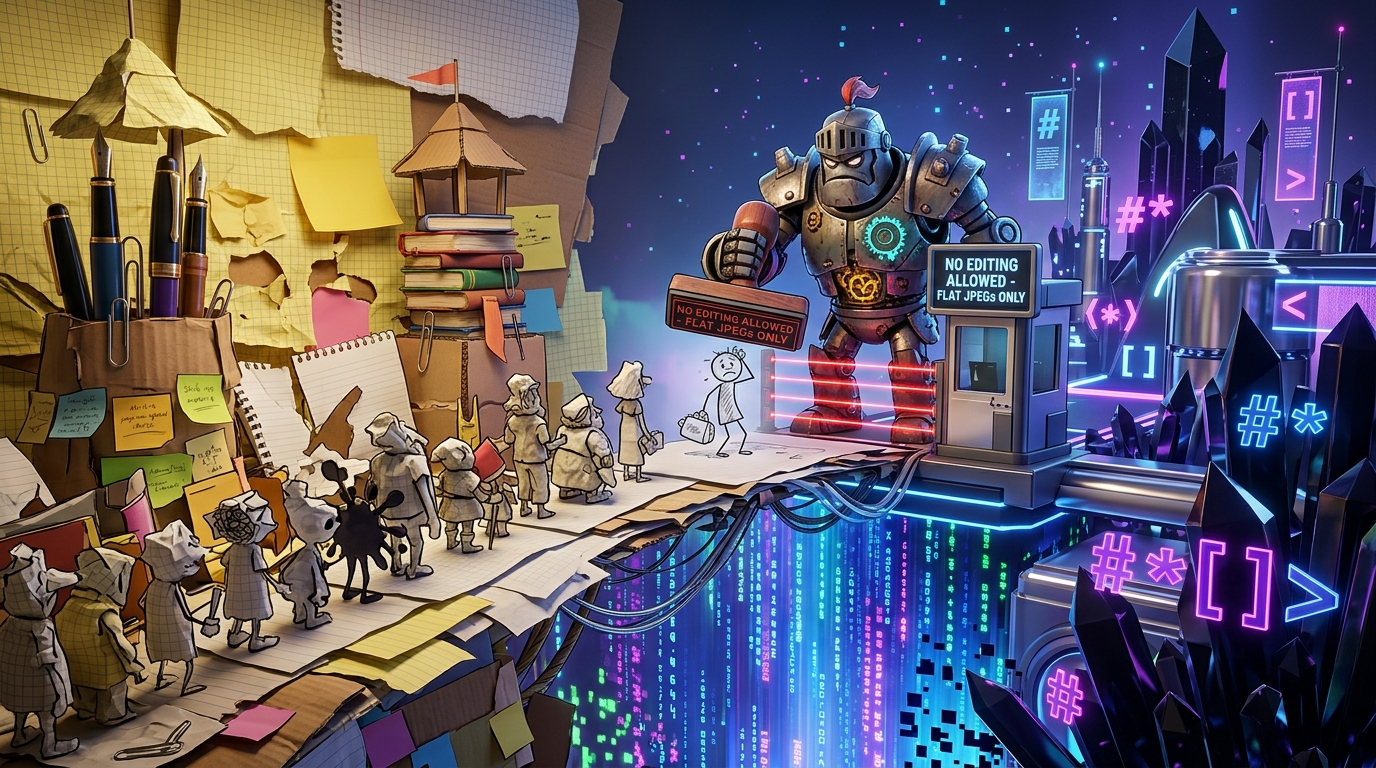
When you drop a photo of a notebook page or a screenshot of an iPad sketch into Obsidian or Notion, it lands as a dead, flat raster image. It looks like a note, but it behaves like a brick:
- Zero Searchability: Six months later, when you search your vault for that specific microservice or lecture concept you mapped out, your search engine glides right over the JPEG as if it were blank.
- Zero Editability: When the project evolves and you just need to rename one box or drag an arrow to a new node, you can't. Your only options are to live with an outdated picture or spend a soul-crushing hour manually redrawing the entire thing from scratch in a diagramming tool.
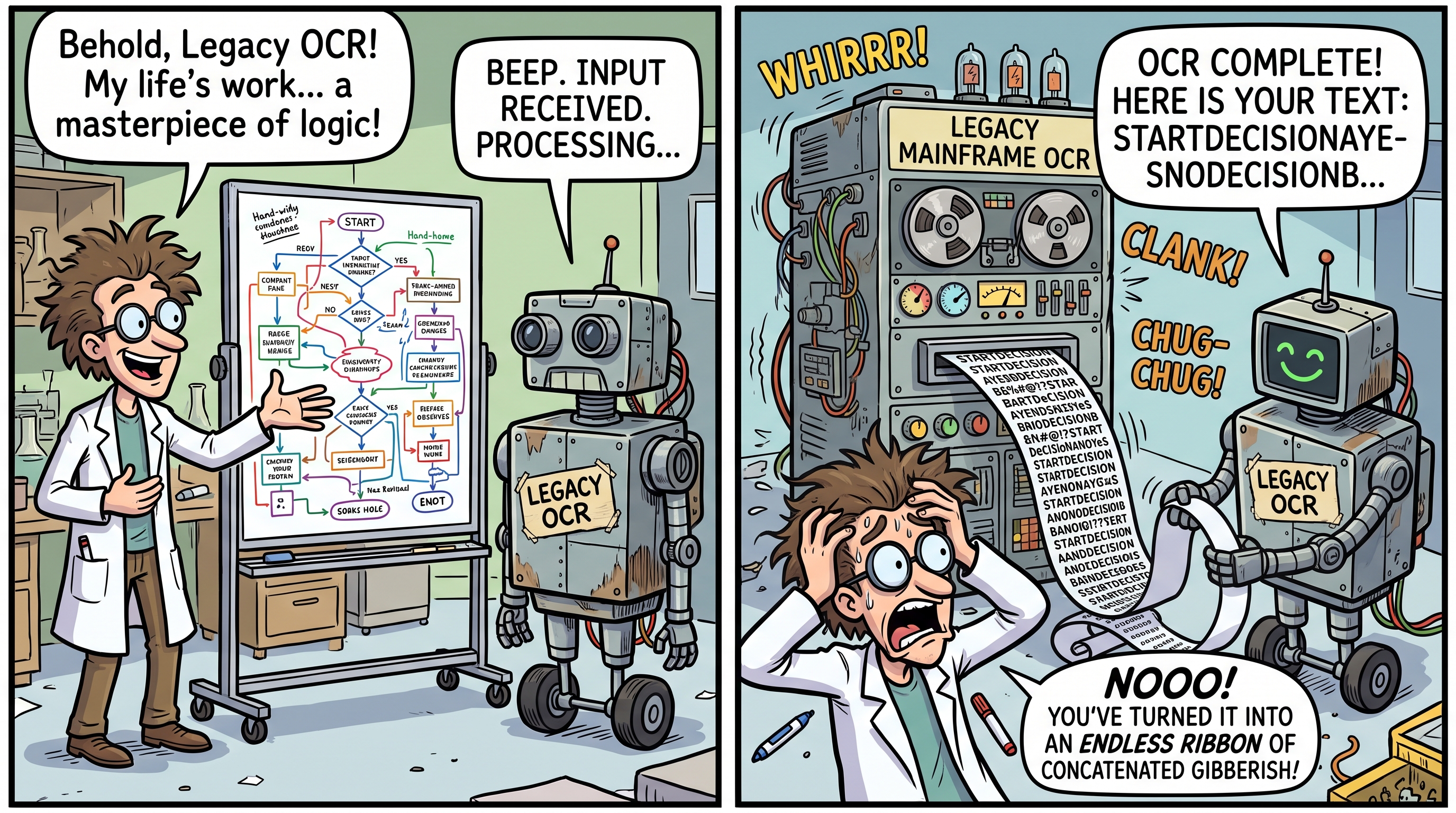
- The Failure of Traditional OCR: "But what about Optical Character Recognition?" you ask. Traditional OCR was built to read flat, linear grocery receipts and printed tax forms. Feed a complex mind map or a whiteboard architecture sketch into a standard OCR engine, and it panics. It sweeps left-to-right, violently flattening your two-dimensional layout into a scrambled 1D soup of out-of-order words, while turning your arrows and boxes into garbled ASCII noise (
//--^~*). 
Enter the Alchemist: Turning Raw Ink into Living Digital Gold
For years, crossing this divide meant choosing between the way your brain likes to think (by hand) and the way your software likes to organize (in structured files). People have tried everything from duct-taping complex Python scripts to cloud APIs to giving up on handwriting altogether.
Thankfully, you can put down the digital duct tape. There is now a practical, effortless bridge across the divide: sketchalchemy.io.
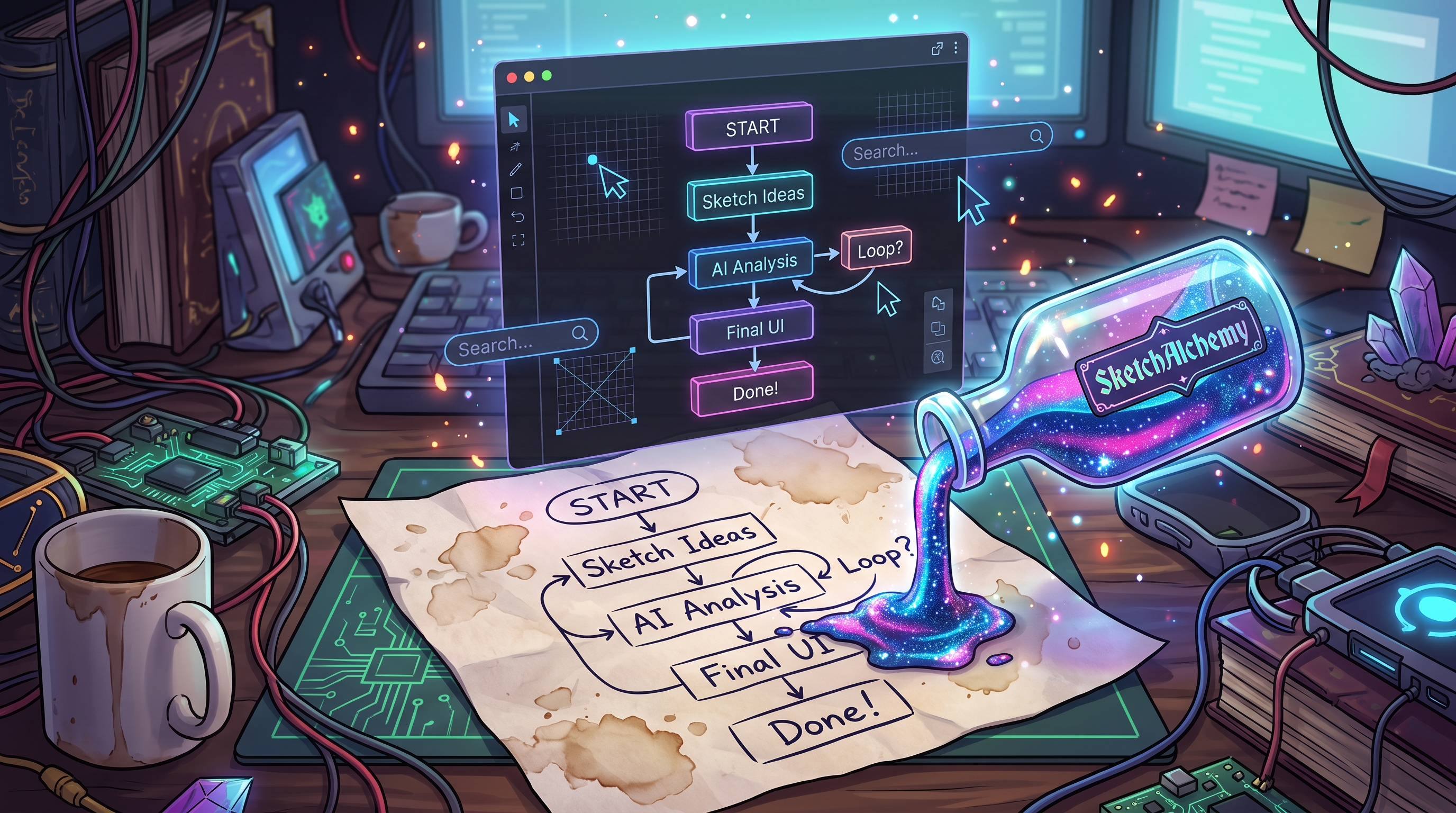
Instead of treating your handwritten notes and diagrams like a flat photograph or a linear page of novel text, SketchAlchemy uses specialized AI to do what we’ve wanted all along: it converts your captured handwriting and sketches into a 1:1 digital representation made of real, editable objects.
Whether you feed it a crooked smartphone photo of a conference room whiteboard, a page exported from a reMarkable or Boox tablet, an iPad scribble, or a scan of a coffee-stained paper notebook, SketchAlchemy transmutes your static capture into a living scene:
- Boxes Become Real Shapes, Arrows Become Real Connections: Unlike generic tools that try to force your drawing into a rigid, unfamiliar corporate template, SketchAlchemy rebuilds your diagram in place. Your original layout, spatial positioning, sizing, and even your color-coding are carried over faithfully.
- Handwriting Becomes Searchable, Typed Text: Every cramped label, sticky note, and bullet point is transcribed into clean, typed text sitting in the exact spot and color you wrote it. Suddenly, your entire visual brainstorm is 100% indexable and searchable inside your digital notebook.
- Native to Excalidraw and Obsidian: SketchAlchemy outputs directly to
.excalidrawor an Obsidian-ready.excalidraw.mdfile (re-baked cleanly for both light and dark vault themes!). You just drop the file straight into your Obsidian vault, where it lives as a native, linkable, searchable atom of knowledge. - Forgiving by Design: Because every element comes back as an independent, object-level vector shape or text box, you are in total control. Did the AI misread a famously messy cursive word, or did you forget to draw a cache layer during the meeting? Just click the label to retype it, drag a box to make room, and draw a new arrow in seconds. Even tiny marginal doodles are preserved as embedded crops so no context is lost.
- Presentation-Grade Cleanup: Need a crisp visual for a client readout or slide deck too? Its Sanitize pass removes paper textures, fixes camera skew, and hands you a pristine 2K PNG alongside your editable diagram.
Stop Redrawing. Start Transmuting.
Your best ideas shouldn't be punished just because they started on the back of an envelope, a sticky-note wall, or an E-Ink slate. You shouldn't have to sacrifice the cognitive superpower of thinking by hand just to keep your digital vault organized, and you certainly shouldn't be spending your Friday afternoons redrawing Tuesday’s whiteboard from a blurry chat photo.
Go dig up that graveyard of unread whiteboard photos and siloed tablet sketches—and give your notes their second life at sketchalchemy.io.